In this Snow (Hey Oh) lesson, we’re going to break down the challenging main riff, as well as the chorus and the outro, so you can finally learn this song from start to finish!
- Home
- Pathways
- Coaching
- Free Lessons
guitar club
by your guitar academy
Get started for free
“
Franco Lacan
“
This song can be challenging for any player as it combines CAGED shapes, licks, precise strumming and lots of small details that make it sounds the way it sounds. Let’s dive in!
The Main Riff
The main riff of Snow is based on 4 chords, G# minor, E, B, and F#. The chord progression itself is pretty common, but it’s the shapes Frusciante plays that makes it so special.
We’re going to play G# minor with a “regular” E minor shape barre chord, but we’ll use a C shape for E and F#, and a G shape for B major. We also have a little inversion for F# that we’re going to play every other time!
We aren’t going to play the “full” shapes, but they would look like this:
Want to learn more about the CAGED?
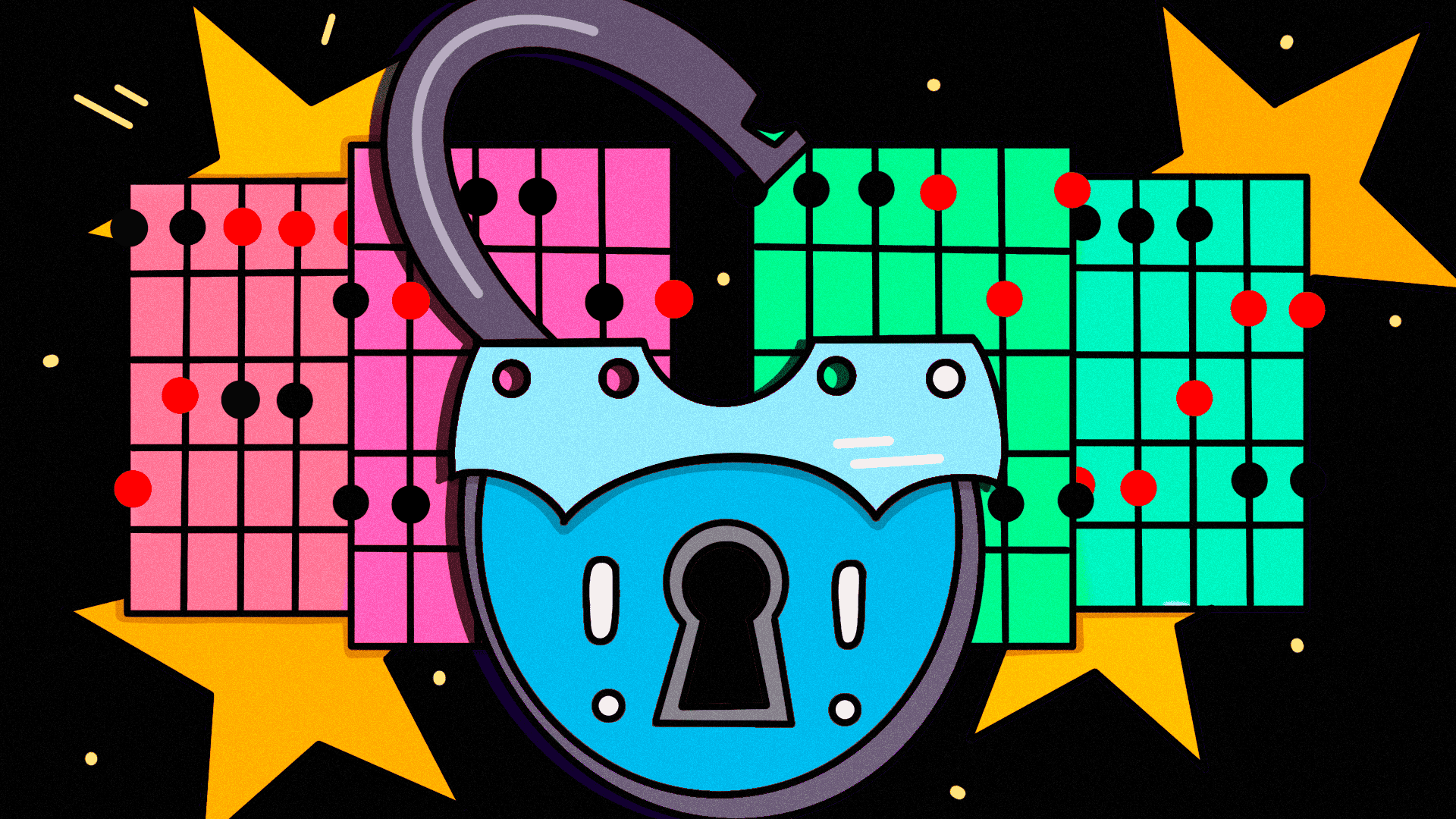
Since we’re just playing three strings per shape, we don’t need to build the whole shape every time! Think of these shapes as a “stripped down” version of the big CAGED shapes we’ve just seen.
Let’s now focus on how to play the shapes, and where the hammer-on will be:
The structure of this riff is pretty simple, we simply play each chord for four beats:
At this stage, the best thing to do is to spend time getting used to playing the chord progression with the shapes we’ve just seen. The more confident you are with them, and the transitions between them, the easier the rest of the riff will be!
When looking at the picking pattern, the trick is to start building the next shape as you finish playing the current one if we can. Basically, once you’ve played the hammer-on, start building the shape of the chord coming up after the one you’ve just played. Speaking of the hammer-on, try and dig in a bit more on it. It will sound more dynamic and more like the original song.
“
If you start feeling confident about the main riff, think about adding an accent on the hammer-on!
Franco Lacan
“
The Pre-Chorus
The pre-chorus of the song is based on three chords, E, F#, and Ab minor. All of them are built using an A shape barre chord shape, but we’re going to strip it back to just two notes, the root and the third.
Even if we’re not playing the full barre chord shape, it’s still important to understand where these smaller shapes come from.
To sound clean playing these shapes, we have to mute the strings we don’t want to hear by resting our index finger onto them. Don’t press too hard, or you’ll fret the strings!
It’s all about finding the right balance, where your index finger just rests on those strings.
The structure of the pre-chorus can be a bit challenging, we’re mainly playing E and Ab minor, but we have F# acting as a passing chord. We’re going to play F# on the second bar, on the “a” of beat 3. We also have a very subtle push on the Ab minor that we’re going to play on the “a” of beat 4 of the same bar!
The pattern is pretty straightforward, we play all the 16th notes with downs and ups! On our downstrokes, we’re going to target the A string, and the upstrokes, we’re going to target the B string.
The only thing to be careful with is your transitions (especially when going to F# and Ab).
Chorus
Let’s now dive into the chorus of the song! We’re going to need three chords, B, F# and C#min(add9).
On the chorus, we want to strum all our 16th notes, with downs and ups, just like we did on the pre-chorus. We’re going to play B for a bar, F# for a bar, and C#min(add9) for two bars!
So that means our structure would look like this:
And the pattern looks like this:
One little detail to help you sound better on C#min(add9): Try to mute the low E and A strings with the middle finger if you can. You can also try to target the higher strings when strumming! Remember to keep your wrist loose and relaxed.
The Outro
Onto the outro! The idea is to add layers to our chorus to make it sound bigger and bigger. That means we have three new shapes, which are variations of our B, F# and C#min(add9).
Just so you know, we’re introducing a new note to our C#min(add9), which technically makes it a C#min9, but that’s for another lesson!
Let’s add our final layer, the unison bends! The idea here is to mimic what Frusciante did on the recording as closely as we can. We’re going to play two strings together, and bend the lowest note until it matches the pitch of the higher one.
Start from position 1, move on to position 2 and 3. Then, start again from position 1, then position 2, but skip position 3 and jump straight to position 4!
What I like to do here is to play around with how precise my bend is, especially on the last position. Feel free to experiment!
In Conclusion
I’m sure this song can be a challenge no matter what your level is, take your time with it and don’t feel bad about staying on the main riff for a while. Snow is milestone for any player, and there’s lots to learn from it!
If you enjoyed this lesson, consider creating a free account! Get your free guitarist's toolbox and try our full courses 🎸🔥