Hello ladies and gentlemen, good people of the internet, this is Jed from Your Guitar Academy. Today we're going to look at Minor Swing by Django Reinhardt, an iconic Gypsy Jazz tune. It's something a bit different, but as it's one of Jed's passions he wanted to share it with you! I hope you enjoy.
- Home
- Pathways
- Coaching
- Free Lessons
guitar club
by your guitar academy
Get started for free
Back to blog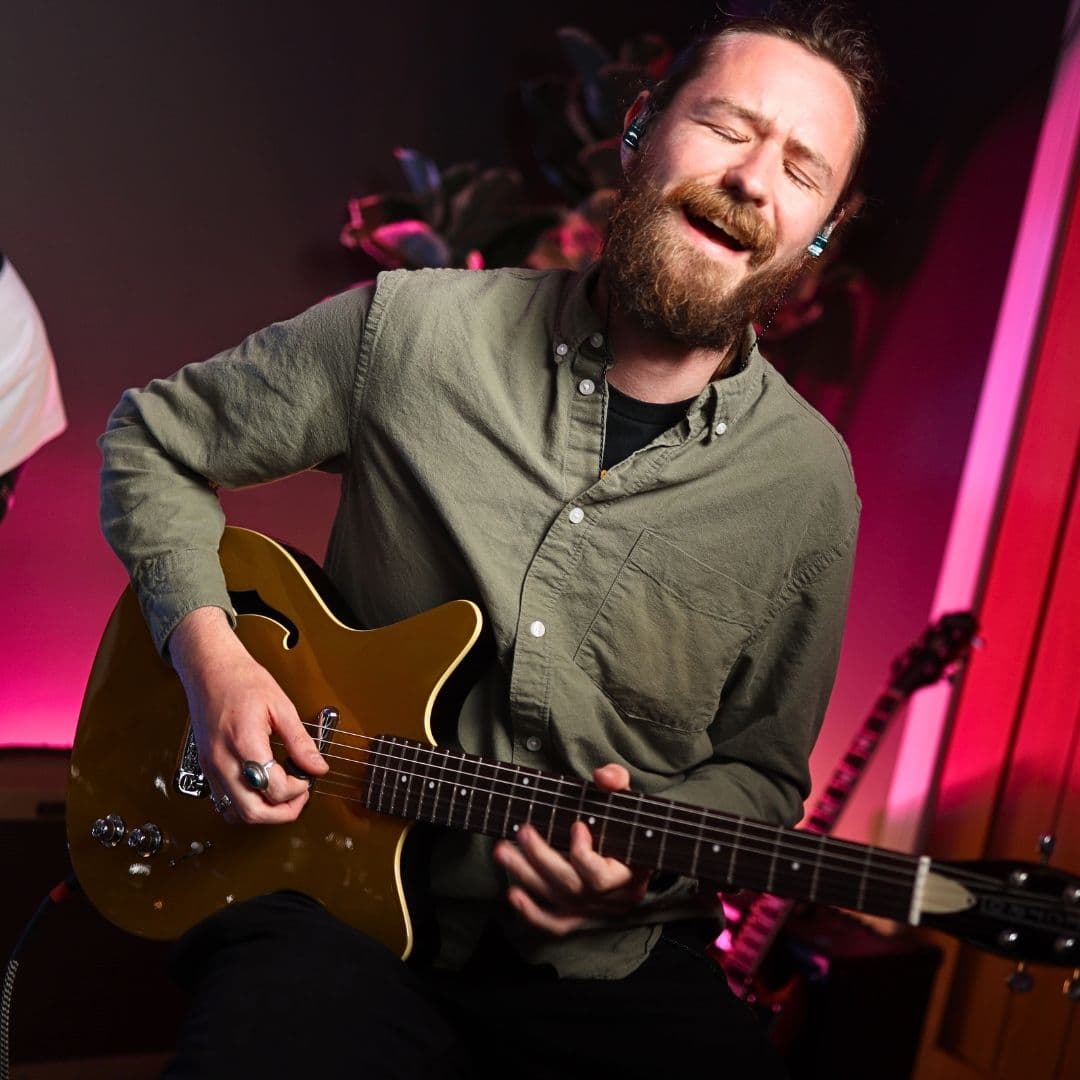

Free guitar lesson
Minor Swing
Django Reinhardt
15 May 2026
Lesson by
Jed Cutler
Write-up by
Ollie Fleming
“
Ollie Fleming
“
History
The tune we're learning today is Minor Swing by Django Reinhardt. He's a legendary guitar player with an incredibly interesting story. He was originally a banjo player but switched to guitar. Which he used to play with all four fingers... However, in the process of rescuing his family from a caravan fire he damaged his left hand, giving him use of only the index and middle fingers! This would be enough to make many players quit but Django Reinhardt retrained himself to play with just two fingers, and played lines that are so fast that they would make even modern day shredders cower! This lesson is aimed at intermediate level players, with some advanced concepts included along the way too.
The Guitar
This guitar is a good example of a traditional gypsy jazz instrument. It has a big sound hole intended to increase the volume, and the strings are metal, not nylon, but they don't feel quite as tight as they do on a standard steel string acoustic. Even if you don't have access to a guitar like this you should absolutely try to play this music on any guitar you do have! If you are interested in learning more about these instruments a good starting place is to know that this guitar is a copy of a Maccaferri guitar.
The Head
As always it's important to know what key we're playing in so that we can develop an understanding of where the chords and melody notes are coming from. In this case we're in the key of A minor. An important term to remember for jazz is the head. This simply means the main melody of the song, which a jazz player would play initially (ie at the beginning of the song, or top of the music sheet, hence the name head), then improvise around later in the song. As we've already mentioned, the song is in A minor, so that should give us a good foundation of notes.
This song has two instruments harmonising for the head, the guitar and originally a violin, but you can of course play this song as a guitar duo. Here are the notes used for each part:
In all music, but particularly in something like jazz it's important to know the underlying harmony, ie the chords we're playing over (even if there isn't an instrument playing them!). The head is played over this progression
You may notice that the melody lines are outlining those chords! After playing the melody three times around the guitar can play a stab on the E7 chord before breaking for the bass line. Here are those shapes for your reference, as they may be unfamiliar shapes!
Improvisation Section
After we've played through the head we move into the improvisation section. In this song the harmony (ie chord progression) does vary from the head, so it's important to run through those chords first. The key is still A minor and the chords are:
So we have a 16 bar progression here. Most of the shapes are familiar now, but note that you can play an inverted Dm6 with the 6 in the bass using the exact same shape as a Bm7b5 chord. This is a really handy voicing!
Le Pomp
This style of music comes with a very distinctive rhythm style called 'Le Pomp'. It may seem simple at first but to get it sounding authentic may take some time! We're basing everything around a strong downstrokes pattern on every beat, with lighter upstrokes after beats two and four. the upstrokes are, are the name of the song suggests, swung! The left hand also plays a very important part in getting this sound. You need to mute immediately after strumming to create a percussive, swinging feel. It also give the soloist a lot of room to play.
“
If you'd like to make things easy for your soloist try playing ahead of the beat so they can really swing!
Ollie Fleming
“
How to Improvise!
Obviously improvising is a huge subject, and a huge part of jazz too, so if you are new to this you may prefer to stick with the knowledge that this is in the key of A minor, and so use the tried and true A minor pentatonic scale over the whole progression and see how that sounds and feels. You may find that it works well or that there are some notes that are a bit more tense than you would like. It's really important to listen as you play and not just autopilot! If you would like to add more colour, and possibly feel more aware of what you're playing read on.
Playing the Changes
Another option, which may feel trickier at first, is to look at all of the chords in the progression and the notes they contain, paying careful attention to the notes that differ between chord changes. Then you can start to try targeting these notes and 'playing the changes'! Let's take some of the chords in the progression to make this idea clearer:
Am6
An A minor 6 chord contains the root, b3, 5 and major 6th. It's very important to note that it's a major 6th and not a minor 6th. It's just a convention in music theory, but it would be an easy thing to overlook!
“
It's worth noting that an A natural minor scale won't work here as the b6 will clash with the major 6 in the Am6 chord!
Ollie Fleming
“
To start with you could just play an A minor triad arpeggio, then gradually take more notes from the chord to add colour. Having this A minor 6 chord suggests Dorian, so if you're looking for a scale to use that would be a good one! Here's a scale shape to get you started:
Dm6
Right away we have a change to be aware of and careful with! If you have been playing Dorian over the A minor 6, that has the potential to clash with the minor 3rd of the Dm6. So here you may want to shift to a D minor or D minor 6 arpeggio, or to D Dorian. Another interesting scale to use here would be the melodic minor scale. That's built with the formula 1 2 b3 4 5 6 7 which gives you some very interesting flavours over the top of the chords, while hitting the root, b3, 5 and 6 in the arpeggio! Here's a shape for anyone wanting to try that:
Remember that you'll still need to follow the chords with this one, so A melodic minor over the Am6 and D melodic minor over the Dm6. There isn't a one size fits all!
E7
For this chord we've moved to a dominant sound, so the Dorian and melodic minors of previous chords won't work as well. You can start off with an E7 arpeggio which is always going to fit nicely as you're only playing notes from the underlying chord. If you want to add a bit more spice to that you can introduce the F note, to get a run that sounds almost diminished. We could describe this as an E7b9 arpeggio.
You can also try the altered scale over the E7 chord to get yet another sound! That a scale that alters every note except the vital root, 3rd and b7th of a dominant chord. It's a bit complicated as you end up with two notes between the root and the major 3rd! We won't go into the theory here, but it's worth a try to see if you like the sound. Here's a shape for you to try:
“
The altered scale can work well over a dominant chord as it preserves the important notes from the chord, but adds a lot of flavour with the altered notes!
Ollie Fleming
“
A7
We move to an A7 from an Am6 so we need to be aware of the notes that change, the most important of which would be the minor 3rd moving up a semitone to a major 3rd. As we've playing over a dominant chord, the altered scale is worth a try again!
This all might feel like a lot to take in to begin with! If you agree, try staring with the triad arpeggios over each chord. Once you can do that comfortably then try introducing the extensions, the 7ths and 6ths and then the altered scale when you're ready! It's certainly a gradual process and familiarity with the CAGED system can help a lot with this too.
Outro
The outro returns us to a head that is similar to the intro, but played over a chord progression that is more reminiscent of the improvisation section - clever! The chord progression is:
The melody over the top is similar to the intro, but we are purely playing arpeggios to fit over the chords.
And finally we end with the quintessential Django chromatic run! With this part a good approach is to use one finger and slide up the frets while alternate picking. Remember this isn't tremolo picking - we're trying to sync up the left and right hands so we only pick each note once. This is something to start with slowly and gradually increase the speed as your hands get used to it.
Picking Technique
Traditionally, Gypsy jazz musicians would not have been performing with amplification, hence the design of the guitar. To make the most of this plays would also make sure to use a technique called **rest strokes** which essentially means picking each new string with a downstroke, and picking through the string and resting the pick on the next string. If you are practicing your picking accuracy it's a really useful technique to work on.
Final Thoughts
This tune is a great introduction to Django and Gypsy jazz in general. There's a lot to learn form this, so take your time! We recommend taking time to work on the various parts individually. You've got the chords and strumming, playing the changes and rest strokes as the headline areas, but you can go very deep with all of that too! Good luck!
Theory and improvisation
We've assumed a reasonably high level of music theory understanding in this lesson. If you would like to brush up please check out our theory lab. If you are new to improvisation and want to get started with something more beginner friendly before coming back to this tune we have a great improvisation level 1 course too!
If you enjoyed this lesson, consider creating a free account! Get your free guitarist's toolbox and try our full courses 🎸🔥