In this Should I Stay Or Should I Go guitar lesson by the Clash, we're walking through every single section in complete detail. The chords, the rhythm and the complete madness of this classic Punk track are all here! Franco and I will be guiding you through it, so let's dive in.
- Home
- Pathways
- Coaching
- Free Lessons
guitar club
by your guitar academy
Get started for free
Back to blog

Free guitar lesson
Should I Stay Or Should I Go
The Clash
27 Nov 2026
Lesson by
Franco Lacan
Write-up by
Dan Holton
“
Dan Holton
“
The Intro
We're in the key of D major for this track, with a cheeky bit of D Mixolydian thrown in at points (the G to F major section), but we certainly won't get bogged down in that for this lesson... If you do have questions about that, get in touch!
For this very first section we only need two chords, and D major and G major. One thing to point out immediately, is that if you're a beginner player, be aware of this transition between these chords. You can basically root your third finger to the third fret of the B string to help you transition smoothly between these two chords! In this intro section we are looking to repeat this pattern of D to G changes 4 times, to make up | D G | D | D G | D | D G | D | D G | D | and the chords look like this:
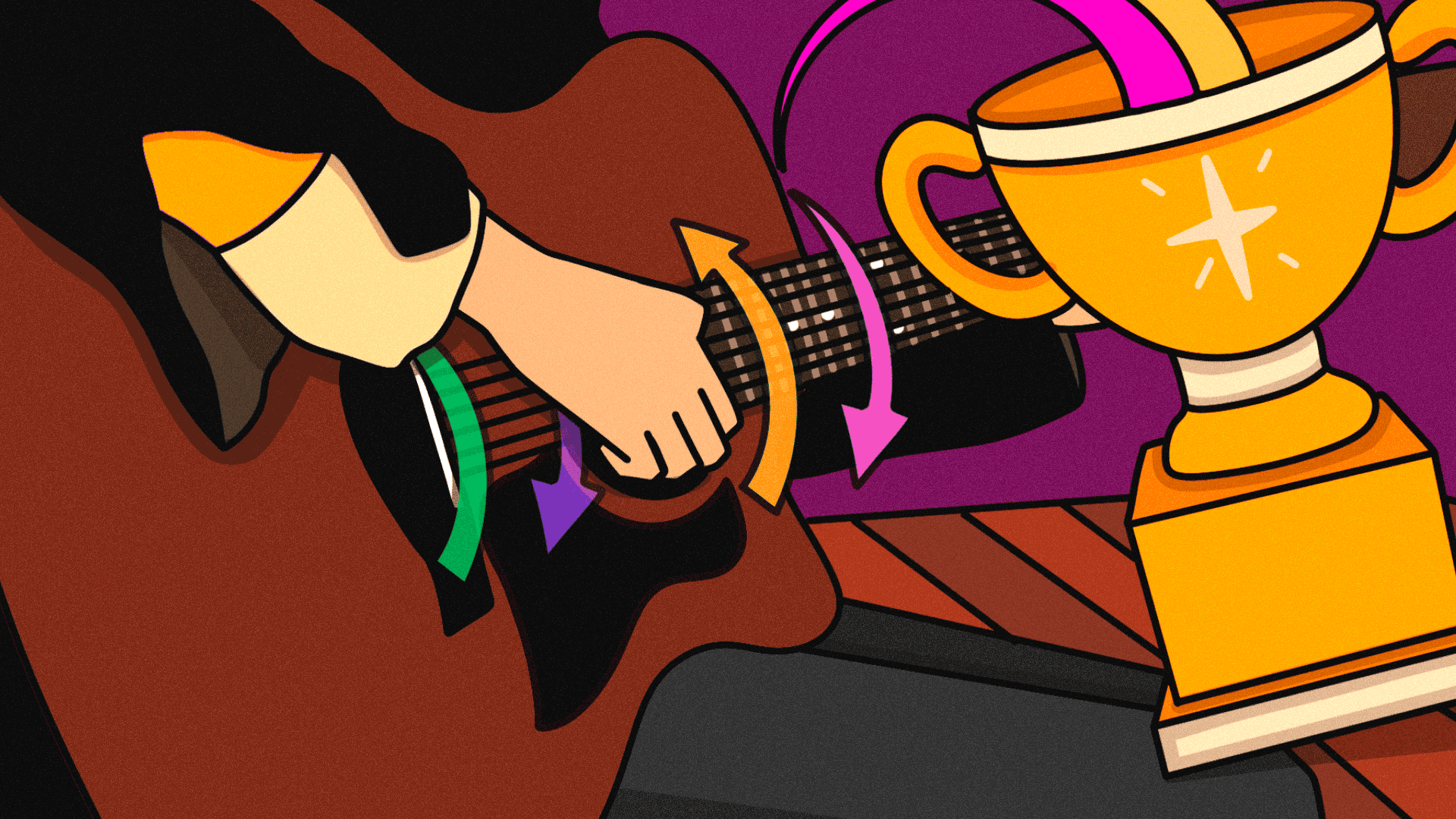
Alongside the chords, it is the rhythm that is the most important element of the track. Coming in "off the 1 beat" is a very cool sound, and means exactly what it says on the tin! Rather than start the chord progression on beat 1, we will be starting on beat number "1 and". Alongside that, we're using completely downstroke strumming, which is a great entry way to 16th note feel, but whilst still counting 8th notes. It looks like this:
Strumming skills
If the counting of the strumming, or perhaps this idea of 16th notes / downstrokes etc are causing you some issues, do check out our strumming course. If you are taking any of our pathways, you will also find this course perfectly positioned within your Electric Pathway Level 1.
Now there are a few other cool bits in the intro of the song. Namely the muted D major barre chord that Franco talks about in the video, as well as the D minor pentatonic box 1 mini lick! You can see both of those visually below:
The Verse
As we now get into the verse, we're basically extending the intro and adding some more chords. The progression is | D G | D | D G | D | G F | G | D G | D | A A7 | A7 | D G | D |. Now with this verse section of chords, you do have a few options. Let's start with the G to F section:
As you can see above, you can use either open chords, barre chords, or even triads based around the E shape barre chord. Franco walks you through it in the video, and below you can see those options, so you can decide. When you get to the A section, it is essentially just an A major chord, but you can hear on the record that they are flirting with an A7 as well. As it's such an easy shift, we might as well add it in. These chords are as shown here:
The final little thing to add here is that you are continuing that core rhythm we talked about right at the beginning. The chords may change, but the way you play them doesn't… Not yet at least!
The Chorus
As you may have noticed, this section has a very different feel. That is because we are moving into double time! This essentially means that we are doubling the rate of the rhythm, or you could think of it as doubling the BPM. It can be a little tricky to get your head round at first, but I would say just imagine you are doubling your speed suddenly! The good news is that the chord progression is exactly the same, but now the chord lengths look a little different, as does the strumming pattern. Like this:
The first chorus just plays around that section once, and the second chorus plays it twice. Notice that the only difference is that in the second chorus we continue playing the A major and final D major section in the double time. This is where you need to know the core of it, and then use your ears when listening to the track.
“
I will say that the shift between the normal speed and the double time can be a little bit tough. In my experience working through this with students, it's actually the shift back to the normal speed. It's like that feeling of coming off a motorway onto a normal residential road, where you need to rapidly half your speed, and suddenly your normal speed feels incredibly slow! Well, that's simply something to be aware of, and get used to as you go through the song! Good luck!
Dan Holton
“
If you enjoyed this lesson, consider creating a free account! Get your free guitarist's toolbox and try our full courses 🎸🔥